
Home › Service Areas › Ham Lake › Iron Stain Removal
ANOKA COUNTY, MN
Iron stain removal in Ham Lake, MN
Those orange streaks are not your fault. They come from your water.
Ham Lake has no city treatment plant, so nothing removes iron from the well water before a sprinkler carries it onto your siding. Dissolved iron is colorless in water, but once it dries on siding, concrete or brick, it oxidizes into orange rust in fans and streaks.
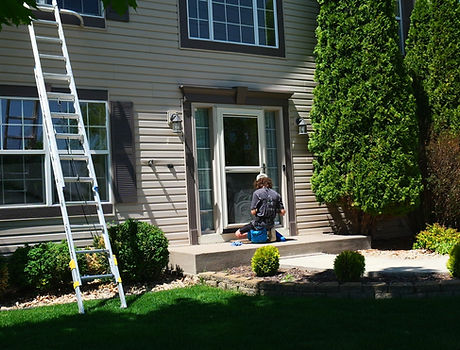
Every stain job starts with a spot test on your surface, and we charge only if it is a job we can complete. Carson Brenny, the owner, does the testing and the treatment himself, and aiming sprinklers at the grass keeps new stains from forming.
OUR STAIN POLICY
Every job begins with a spot test, and we charge only for work we can complete.
★ Rated 4.9 on Google · 44 reviews
Insured to $2M
Owner-operated
Based in Ham Lake
HAM LAKE SPECIFICS
What iron stain removal means in Ham Lake
The local conditions that shape how Glass House approaches iron stain removal in Ham Lake, and the standards it holds to on every visit.
WATER
A private well at every home
Ham Lake has no city water system. Every property runs on its own private well, on a lot of at least one acre, so sprinklers apply groundwater exactly as it leaves the ground. Minnesota groundwater commonly carries dissolved iron and hardness minerals. When sprinkler spray dries, the water evaporates and the minerals remain: iron oxidizes into orange stains on siding and concrete, and calcium leaves white spots on glass.
WATERING
No city watering schedule
With no city water system, Ham Lake has no odd/even watering schedule, so sprinklers run whenever they are set to run. A sprinkler head aimed at the house wets the same stretch of siding, glass or driveway on every cycle. Each time the spray dries, another thin layer of iron and minerals stays behind, and those layers build into orange fans on siding and concrete.
HOMES
A median home built in 1994
The median Ham Lake home was built in 1994, and about 45% of homes date from the 1990s and 2000s. After about three decades of sunlight, the surface of vinyl siding, painted trim and gutters breaks down into a chalky film, a process called oxidation. Rain running over the chalk leaves streaks, and the roughened surface gives dirt and algae a better grip. Aged paint and oxidized siding can be fragile, so a damage waiver may come before stain work.
OUR HOME BASE
Owner-operated from Ham Lake
Glass House is owner-operated and based in Ham Lake, and Ham Lake homes are the shortest drive on our route. The person who quotes a Ham Lake home is the person who does the work, so every detail discussed at the quote is carried out by the same person, with no crew or subcontractor in between.
Sources: City of Ham Lake, History of Ham Lake; Minnesota DNR, Blaine-Ham Lake well interference fact sheet (2023); Point2Homes, Ham Lake demographics (U.S. Census ACS 2019-2023).
HOW WE REMOVE IT
Iron needs chemistry, not force
Rust is among the most stable stains there is. It does not dissolve in water, and no pressure or scrubbing changes that. It comes off when the right product converts it into a form that rinses away.
WHY BLEACH MAKES IT WORSE
Bleach is an oxidizer, and rust is iron that has already oxidized, so bleach sets the stain deeper and leaves chloride salts behind. It is the most common mistake we see, and it is why iron and organic growth are treated as two separate jobs.
01
Identify it and spot test
We confirm the stain is iron rather than manganese, efflorescence or oil, then test the product on your surface. Some stone, colored concrete and polished finishes can etch or bleach, and a test spot settles that before anything else happens.
02
Clean the surface first
On concrete, the slab is first cleaned with a degreaser and a surface cleaner, the pressure-washing tool made for flat concrete, then rinsed thoroughly, so organic staining comes off before any acid touches it. Clean concrete has open pores, which let the treatment reach deeper and pull out more of the stain.
03
Apply evenly with a pump sprayer
We use F9 BARC, the trade standard for rust and well-water staining. It goes on evenly across the whole area on the first pass, rather than spot by spot, so you do not end up with clean patches around each stain or a mottled finish across the slab.
04
Let the surface decide the method
On porous concrete, the product dries into the slab and the stain fades as it dries. On siding, stucco and sealed surfaces, it dwells a few minutes while the stain visibly lightens, then is rinsed before it can dry. Where spots remain, a lighter second application follows.
05
Rinse gently, and protect everything
Plants and surroundings are wet down before, during and after, so any overspray is diluted to the point of being harmless. Please keep people and pets off treated areas for at least 3 hours afterward.
FOR HAM LAKE HOMES
What to know before your visit
SPRINKLERS
Aim at grass only
Aim every head at the grass, never at the house. That one change solves most iron staining, and stopping garden-hose overspray on the siding handles much of the rest.
FERTILIZER
Sweep the concrete
Most lawn fertilizers contain iron. A spreader throws granules onto walks and driveways, and each one that gets wet leaves a small orange spot, so blow them off before watering.
FURNITURE
Move metal now and then
Metal furniture feet, planters and grills left in one place through a season can leave rust rings, so shift them now and then to keep new spots from forming.
SPIGOTS
Filter the water
If staining keeps returning, filters on the outside spigots can strip the minerals before the water leaves the house. They are not inexpensive, but they are sometimes worth it.
HOW PRICING WORKS
The spot test comes first
YOUR STAIN JOB, AT A GLANCE
QUOTE IN PERSON
Spot test on your surface
Always first
Every product on every surface, before any work begins
Iron or manganese removal
Quoted
Priced after Carson sees the stain and the surface
If it will not lift
No charge
If the spot test shows we cannot complete it, you do not pay
Well water still reaching it
Included
Advice on stopping the source, so the result lasts
Builders and commercial sites
In person
Quoted in person by Carson
Every stain is different
Spot test first
Iron stain removal is quoted in person, because the result depends on the age of the stain, the surface and the source of the iron. Carson inspects it, runs a spot test and tells you plainly what will lift before any work starts.

THE OWNER
The person who quotes your home does the work
Glass House is owned and run by Carson Brenny, with no crews, subcontractors or handoffs. He grew up in Ham Lake, went to Blaine High School and has worked full-time in exterior cleaning for six years. The person who quotes your home is the person who arrives, does the work and walks it with you at the end.
Every job receives the gentlest method that will do the work, because too much force or too strong a mix can cause damage that no cleaning undoes. Every homeowner receives a clear explanation of what is on the house, why the method was chosen and what cleaning can and cannot fix, before any money is spent.
IN CARSON'S WORDS
“It's my neighbors' homes: their biggest investment, one of the places they spend the most time, and where the people they care about most live. It's something everyone should enjoy, and I believe that.”
Carson Brenny, owner
WHAT IS INCLUDED
What iron stain removal includes and excludes
Iron comes off with the right chemistry. Stopping the next stain depends on where the water comes from.
INCLUDED
In every iron stain job
• A spot test before the full job
• Iron-specific chemistry, never bleach
• Siding, concrete, brick, stucco and stone
• Dark brown manganese stains, treated the same way
• Plants and surroundings wet down before, during and after
NOT INCLUDED
Outside iron stain removal
• Sprinkler adjustments or well water treatment
• A promise that years-old, bonded stains come out completely
• Oil, grease and efflorescence, which need other chemistry
• Hard water spots on glass, a separate service
EQUIPMENT AND METHODS
Chemistry, not force
F9 BARC, from Front 9 Restoration, is the trade standard for metallic staining: non-abrasive, non-flammable and safer to work with than hydrochloric acid. It goes on through a dedicated pump-up sprayer, is worked gently with soft-bristle brushes and dwells 5 to 15 minutes. The rinse is gentle, ideally with our soft wash system.
HAM LAKE QUESTIONS
Iron Stain Removal in Ham Lake: FAQ
Will orange stains on my Ham Lake home come back after treatment?
Treated stains stay gone only if the source stops. If a sprinkler head still reaches the siding or driveway, the rust returns, so the sprinkler conversation happens before the quote. Individual spots on concrete can also return when the iron comes from pyrite, a mineral in the aggregate itself, and we say so rather than treat the same spot twice.
Do you serve all of Ham Lake?
Yes, every neighborhood. Glass House is based in Ham Lake, so homes here are the shortest drive on the route and there is never a trip fee. Carson often works within a few miles of where he grew up, and he quotes, cleans and walks every job himself.
Can I use bleach on rust stains?
No. Bleach is an oxidizer, and rust is iron that has already oxidized, so bleach sets the stain instead of lifting it. Never use bleach and a rust remover together, or one after the other without a full rinse and dry, because the combination produces chlorine gas.
Will pressure washing get it off?
No. Rust does not dissolve in water, so pressure alone cannot lift it, and blasting a rust stain drives the iron deeper into the pores. Iron comes off with an acid or chelating treatment that converts the rust into a form that rinses away, followed by a gentle rinse.
What about black or dark brown stains?
Those are usually manganese, another metal found in our well water. Manganese belongs to the same family as iron and is treated the same way, with F9 BARC. We do not call it rust, because it is not, but the spot test and the removal process are the same.
Can you remove iron stains from windows?
Yes, but glass receives its own treatment, because F9 BARC never goes on glass. Mineral staining on windows, including the white calcium spots left by the same well water, is handled by our Hard Water Stain Removal service, added to a window cleaning and tested on one window first.

